

Lane Keeping
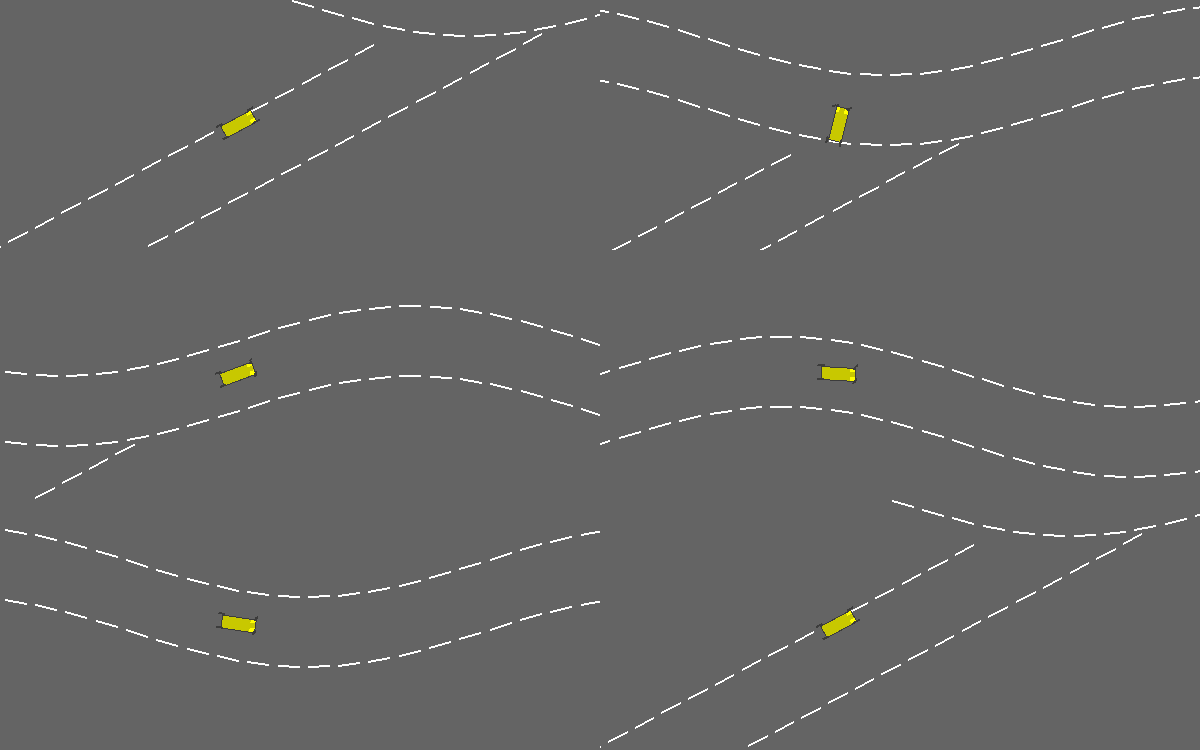
A pure lateral control task using a bicycle dynamics model. The agent must steer to follow a sine-wave lane with no other traffic. The reward is maximised when the vehicle stays centred on the lane.
Usage
env = gym.make("lane-keeping-v0")
Default configuration
{
    "observation": {
        "type": "AttributesObservation",
        "attributes": ["state", "derivative", "reference_state"],
    },
    "action": {
        "type": "ContinuousAction",
        "steering_range": [-np.pi / 3, np.pi / 3],
        "longitudinal": False,
        "lateral": True,
        "dynamical": True,
    },
    "simulation_frequency": 10,
    "policy_frequency": 10,
    "state_noise": 0.05,
    "derivative_noise": 0.05,
    "screen_width": 600,
    "screen_height": 250,
    "scaling": 7,
    "centering_position": [0.4, 0.5],
}
More specifically, it is defined in:
- classmethod LaneKeepingEnv.default_config() dict[source]
Default environment configuration.
Can be overloaded in environment implementations, or by calling configure(). :return: a configuration dict
API
- class highway_env.envs.lane_keeping_env.LaneKeepingEnv(config: dict = None)[source]
A lane keeping control task.
- classmethod default_config() dict[source]
Default environment configuration.
Can be overloaded in environment implementations, or by calling configure(). :return: a configuration dict
- step(action: ndarray) tuple[ndarray, float, bool, bool, dict][source]
Perform an action and step the environment dynamics.
The action is executed by the ego-vehicle, and all other vehicles on the road performs their default behaviour for several simulation timesteps until the next decision making step.
- Parameters:
action – the action performed by the ego-vehicle
- Returns:
a tuple (observation, reward, terminated, truncated, info)